
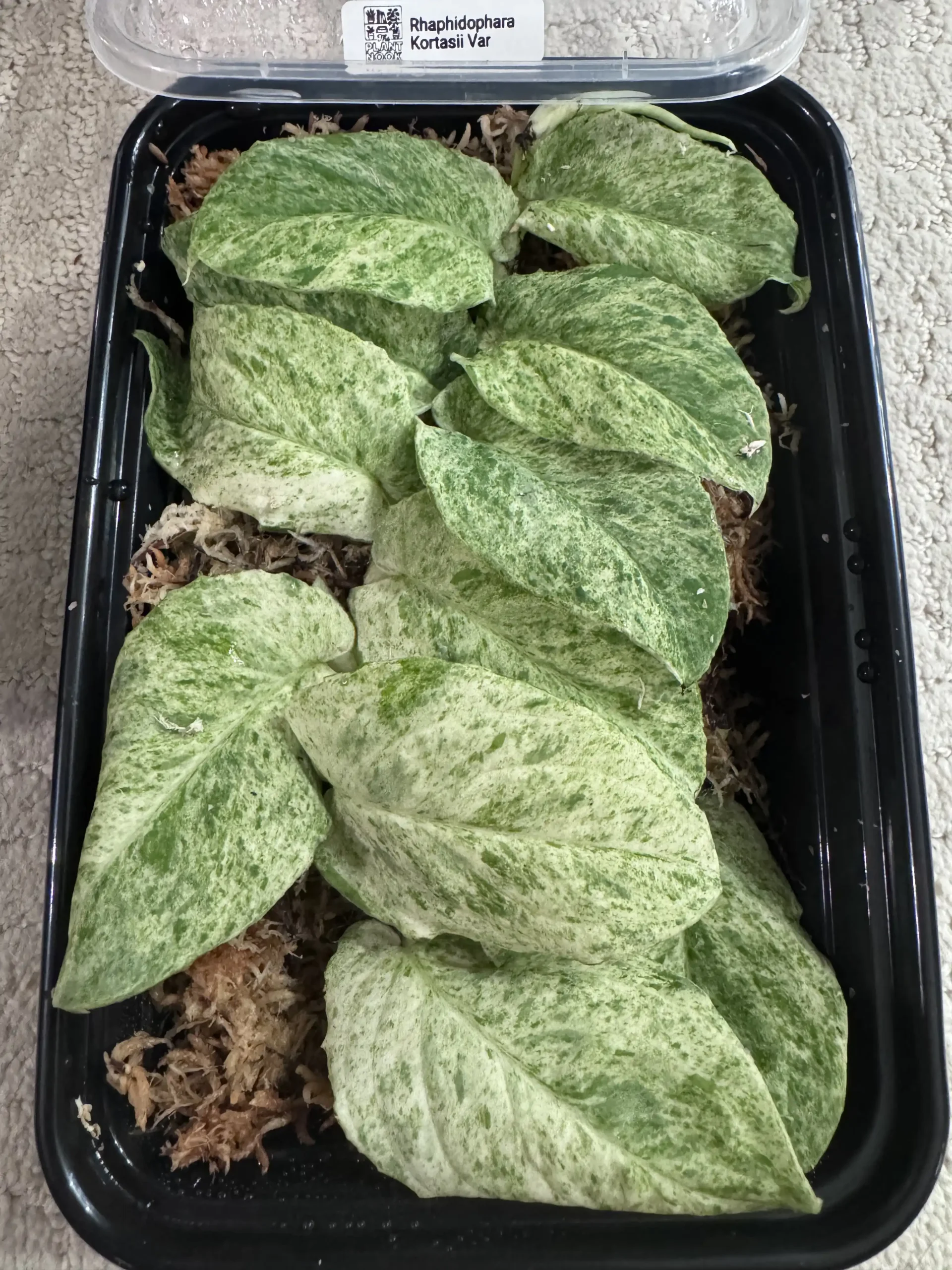
Rhaphidophora Korthalsii Variegated
$50.00
In stock
Growers Choice rooted plant in box with moss
Rhaphidophora Korthalsii Variegated – Grower's Choice Rooted in Moss
The Rhaphidophora korthalsii is the kind of plant that makes you rethink what a houseplant is supposed to do. It does not sit in a pot and look pretty. It climbs. It shingles. It transforms. And in its variegated form, it does all of that while displaying a living mosaic of creamy white, pale lime, and rich emerald green that is different on every single leaf. Our Grower's Choice specimens are fully rooted, established in a moss box for healthy root development, and ready to climb the moment they arrive. What you get is a genuinely rare plant at an accessible price, packaged to travel safely and arrive ready to grow.What Makes This Plant Extraordinary
The korthalsii is native to the lowland and hill dipterocarp forests of Southeast Asia – a wide natural range that includes southern Thailand, Peninsular Malaysia, Sumatra, Borneo, Java, Sulawesi, and the Philippines. It grows epiphytically up tree trunks and over boulders, clinging and ascending through humid forest shade from sea level up to about 1,500 meters. What it does when it climbs is what sets it apart from nearly every other plant in the Araceae family. In its juvenile shingling stage, the leaves press completely flat against whatever surface the plant is climbing, overlapping each other in tight, scaled rows like architectural tiles. There is no gap between the leaf and the surface – the entire blade adheres, and the effect is stunning. As the plant matures and gains vertical height – typically after 2 to 5 meters of climbing in strong filtered light – something remarkable happens. The leaves detach from the surface, grow dramatically larger, and eventually transform into broad, divided, deeply lobed adult foliage that can exceed 50 cm in length. One plant. Two completely different leaf morphologies. Both beautiful.The Variegated Form
The standard korthalsii is already a collector plant. The variegated form is rarer and more visually complex. In its variegated expression, the classic deep green shingling leaves become a mosaic – patches of creamy white and ivory, sections of pale mint and lime green, and rich emerald green base color layered together across each leaf in patterns that are never the same twice. The variegation is unpredictable, chimeric, and genuinely one of a kind per leaf. As the plant climbs and the leaves tile against your moss pole or climbing surface, those variegated patterns stack on top of each other in overlapping layers, creating a wall effect that looks designed rather than grown. Experienced collectors describe it as living art. That description is accurate.Key Features
- Rare shingling growth habit – juvenile leaves press completely flat against climbing surfaces in tight overlapping rows
- Unique marbled variegation in creamy white, mint green, and dark emerald – no two leaves identical
- Dramatic juvenile-to-adult transformation – leaves eventually grow large, detach from the surface, and develop deep lobing and division
- Vertical climber – moss pole, tree fern post, or wooden plank will maximize growth and leaf development
- Compact and dramatic – ideal for small-space indoor gardens with outsized visual impact
- Grower's Choice listing – fully rooted, established in moss box, ready to climb on arrival
- Highly collectible – genuinely rare in the variegated form, prized by serious aroid collectors worldwide
About the Grower's Choice Moss Box Format
This listing ships fully rooted plants established in a moss box – a setup that keeps the root system healthy and hydrated during transit and gives the plant an excellent foundation for transitioning to its permanent growing environment when it arrives. Simply unbox, mount or pot with your preferred support structure, and let it climb. The moss root system transitions easily into an aroid mix or onto a moss pole.Care Guide
Light: Medium to bright indirect light is the target. The korthalsii evolved in humid forest shade and performs well across a range of indirect light conditions – from moderate ambient light near a north-facing window to bright filtered light near an east or west-facing exposure. Better light means faster growth, larger leaves, and a quicker transition from juvenile shingling to mature adult foliage. A grow light placed 20 to 40 cm above the plant works very well. No direct sun – the juvenile leaf tissue is particularly sensitive to direct exposure and will scorch quickly. Climbing support: This is not optional – it is the single most impactful thing you can provide for this plant. A moss pole, coco coir totem, tree fern post, or flat wooden board will trigger the shingling behavior and encourage the plant to produce the tight, overlapping leaf arrangement it is known for. Without a vertical surface to cling to, the korthalsii trails and stays in a less defined, less visually compelling juvenile form. Install your support at potting time and train the stems to contact the surface – the aerial roots will do the rest. Watering: Keep the growing medium evenly moist but never waterlogged. Water when the top 2 to 3 cm of the medium approaches dryness, then water thoroughly and let it drain fully. The korthalsii is more tolerant of consistent moisture than many aroids due to its natural habitat in year-round humid forest conditions – it does not want extended dry periods. Check the plant twice a week during active growing season and once a week in cooler months, adjusting based on your specific environment. Humidity: 60 to 80 percent is the sweet spot. Daytime humidity around 80 percent and nighttime humidity around 60 percent mirrors its natural forest conditions most closely. High humidity promotes larger leaves, cleaner margins on the variegated areas, and faster vertical growth. A humidifier is the most consistent solution. Misting the leaves and the moss pole directly is acceptable for this species and can help maintain surface moisture that encourages the aerial roots to cling more effectively. Temperature: Warm and consistent between 18 and 28 degrees Celsius (65 to 82 degrees Fahrenheit). Growth slows noticeably below 16 degrees Celsius and the plant is not frost tolerant. Stable warmth with no cold drafts or temperature fluctuations is what this plant wants. Keep it away from air conditioning vents and cold windows in cooler months. Soil and potting: A chunky, well-draining aroid mix works well. A blend of 40 percent quality potting compost, 30 percent medium orchid bark, 20 percent perlite or pumice, and 10 percent coco coir provides the right balance of moisture retention and airflow that the root system needs. Encourage the aerial roots to contact moist moss on the support pole for faster establishment and upsizing. Repot every 2 years or when roots begin to outgrow the container. Fertilizing: Light and regular during the growing season. A balanced liquid fertilizer every 4 to 6 weeks in spring and summer supports steady growth and leaf quality. Slow release granular fertilizers incorporated into the potting mix also work very well for this species. Reduce to once a month or less in fall and winter when growth naturally slows. Toxicity: Rhaphidophora korthalsii contains calcium oxalate crystals in its tissues and is toxic to cats, dogs, and humans if ingested. KeepEvery Leaf Tells a Story in our collection. Hand-selected, carefully shipped, and trusted by plant lovers nationwide. Get first access to limited genetics and healthy, acclimated plants.
© 2026 The Plant Nook Shop
Powered by SmallBiz.Reviews