
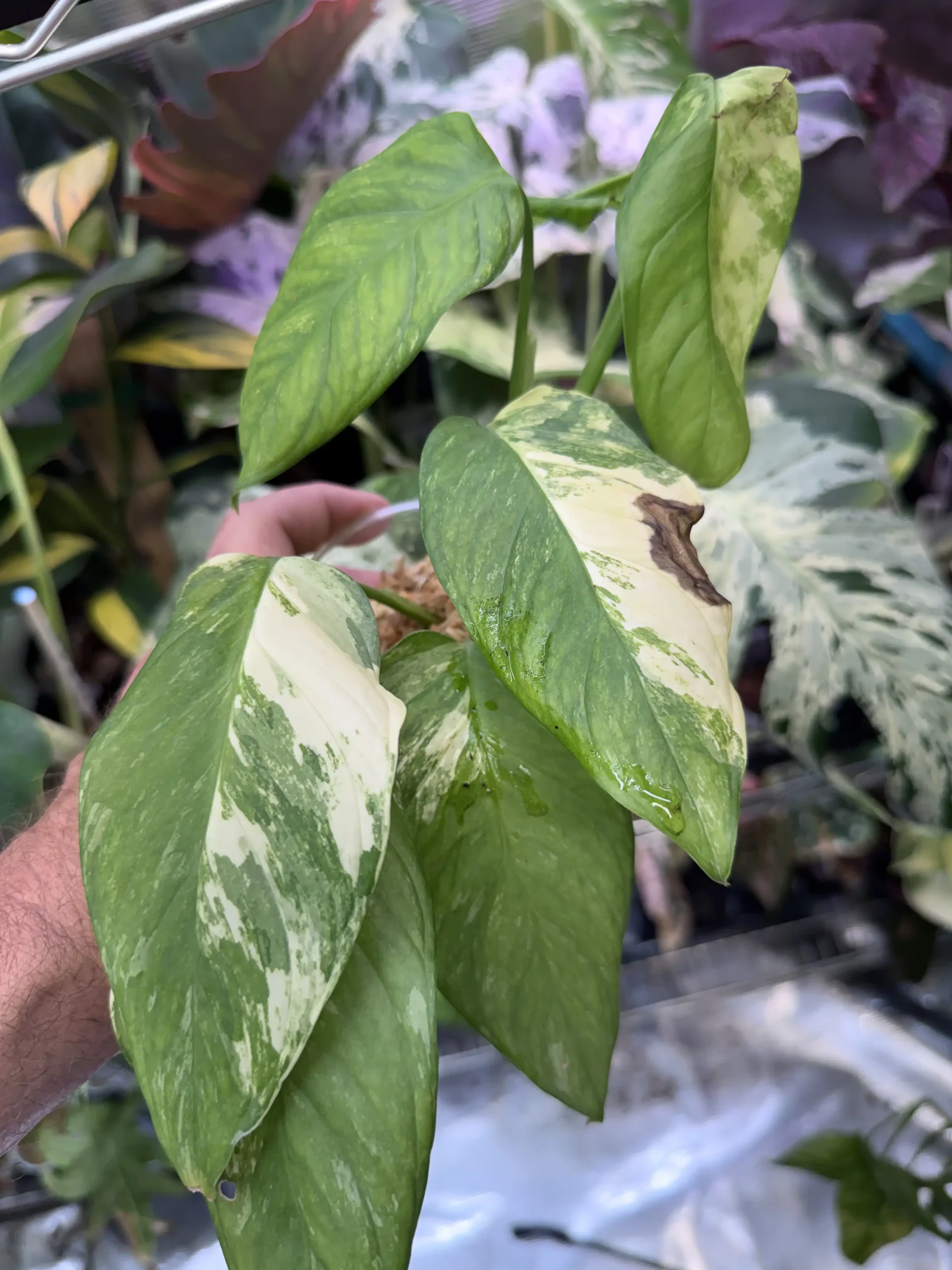
Monstera Mayuna Variegated #601
$55.00
In stock
Exact Plant
Image taken 5-20-26
Monstera Mayuna Variegated – Exact Plant #601
If you follow the collector aroid world closely, you already know what Monstera obliqua is and why it matters. If you are newer to the hobby, here is the short version: it is one of the rarest wild Monstera species on the planet, famous for producing leaves that are more fenestration than leaf material as the plant matures – a level of perforation that no other Monstera comes close to. The Mayuna form is an affiliated variety from the Peruvian Amazon, and its variegated expression makes an already extraordinary plant genuinely remarkable. Exact Plant #601 is fully rooted, actively growing, and ships exactly as photographed.The Lineage Behind the Name
In botanical shorthand, this plant is correctly identified as Monstera obliqua aff. Mayuna variegated. The "aff." designation means this specimen is closely affiliated with the obliqua species from the Mayuna region of the Peruvian Amazon – a geographic designation that tells you something specific about its leaf form, growth characteristics, and the particular expression of fenestration it is expected to develop. Collector communities use "Mayuna" as the shorthand, and the name has stuck. The Monstera obliqua has a reputation that is almost mythological in collector circles. In the wild, mature obliqua leaves can reach a state where the fenestrations are so extensive that the solid leaf blade accounts for less surface area than the holes themselves – an architectural extreme that no other plant in the genus achieves. The leaves look like they were assembled from leaf fragments held together by veins. The Mayuna form carries this potential while expressing it in a way that is somewhat more accessible in cultivation than the most extreme pure obliqua specimens.The Variegated Form
Add variegation to this already extraordinary species lineage and the result is something the collector market consistently describes as a dream plant. The variegated Mayuna presents creamy white and green marbling across the fenestrated leaf surface – an interaction between the variegation patterns and the developing holes that creates a visual result unlike anything else in the Monstera family. No two leaves will express the same combination of fenestration placement and variegation distribution. Patches of cream appear on different sections of the blade on every new leaf. The fenestrations open differently each time. The result is an endlessly changing, deeply textured plant that rewards close attention.- Monstera obliqua affiliate from the Mayuna region of the Peruvian Amazon – one of the rarest species in the genus
- Creamy white and deep green marbled variegation – unique pattern on every single leaf
- Develops extensive fenestrations as it matures – leaves become increasingly perforated over time
- Glossy, heart-shaped leaves that grow larger with age and maturity
- Vigorous climber – leaf size, fenestration development, and variegation all improve on a moss pole or support
- Highly sought after and rarely available – a true collector-level aroid at an accessible price point
Care Guide
Light: Bright indirect light is ideal for both growth rate and maintaining the cream variegation. The Mayuna performs well in a range of indirect light conditions but will produce faster growth, larger leaves, and more vivid variegation with consistent quality light – near an east or west-facing window, or under a grow light at moderate intensity for 12 to 14 hours per day. The variegated sections of the leaf contain less chlorophyll than the green tissue, so this plant needs slightly more light than a standard all-green Monstera to maintain the same pace of growth. Avoid direct sun entirely – the delicate fenestrated foliage is sensitive to bleaching and scorch. Watering: Keep the growing medium evenly moist but never waterlogged. Water when the top inch of growing medium approaches dryness, then water thoroughly and let it drain fully. The obliqua lineage is notably more moisture-sensitive than the robust deliciosa – this is a plant that appreciates consistent, attentive watering rather than the drought-tolerant approach that works fine with larger Monstera species. Never let it sit in standing water. Filtered or room-temperature water is recommended, as the delicate foliage can show sensitivity to fluoride and heavy mineral content over time. Humidity: High humidity is non-negotiable for this species lineage. Aim for 70 to 85 percent. In the wild, Monstera obliqua grows in environments where humidity is consistently at or near saturation, and the delicate fenestrated foliage reflects that adaptation. At lower humidity levels the leaf margins dry out, tips brown, and the overall vigor of the plant declines noticeably. A dedicated humidifier, grow cabinet, or terrarium setup are the most effective solutions. A terrarium is actually an excellent environment for this species – the enclosed high humidity environment produces exceptional results. Temperature: Warm and stable between 65 and 82 degrees Fahrenheit (18 to 28 degrees Celsius). The obliqua lineage evolved in the consistently warm Peruvian Amazon and does not tolerate cold or temperature fluctuations. Keep it away from cold drafts, air conditioning vents, and cold window glass in cooler months. Climbing support: A moss pole, trellis, or coco coir totem is essential for bringing out the Mayuna's full potential. In its juvenile form the plant stays compact and the leaves are smaller and less fenestrated. As it gains height on a support structure the leaves grow progressively larger, develop more extensive fenestrations, and express the variegation across a larger surface area. Installing support early is the most effective approach – the plant will grow toward it naturally once given the opportunity. Soil: A chunky, well-draining, moisture-retentive aroid mix. The obliqua lineage wants consistent moisture without waterlogging – a blend of orchid bark, perlite, coco coir, and quality potting soil in roughly equal parts achieves this well. Some collectors grow this species in pure sphagnum moss with excellent results, particularly in terrariums where moisture retention is easier to manage. Avoid dense, compacting soils that hold standing water against the root system. Fertilizing: Light and consistent. A balanced liquid fertilizer at quarter to half strength every 4 to 6 weeks during active growing season supports steady growth. The obliqua lineage is not a heavy feeder – gentle, regular nutrition is preferable to infrequent heavy doses. Reduce to every 8 weeks or less in fall and winter when growth naturally slows. Toxicity: Monstera obliqua Mayuna variegated is toxic to cats, dogs, and humans if ingested. Contains calcium oxalate crystals which cause oral irritation, swelling, and gastrointestinal distress. Keep away from pets and children at all times.Shipping
This is an exact plant listing – Plant #601 ships precisely as shown in the product photos. We ship Monday through Wednesday to avoid weekend transit delays. Every plant is carefully packaged to protect the delicate fenestrated foliage and root system during transit. Given the delicate nature of the obliqua foliage, we take extra care with packaging for this species. Reach out before ordering if you have any questions about this plant.Every Leaf Tells a Story in our collection. Hand-selected, carefully shipped, and trusted by plant lovers nationwide. Get first access to limited genetics and healthy, acclimated plants.
© 2026 The Plant Nook Shop
Powered by SmallBiz.Reviews