
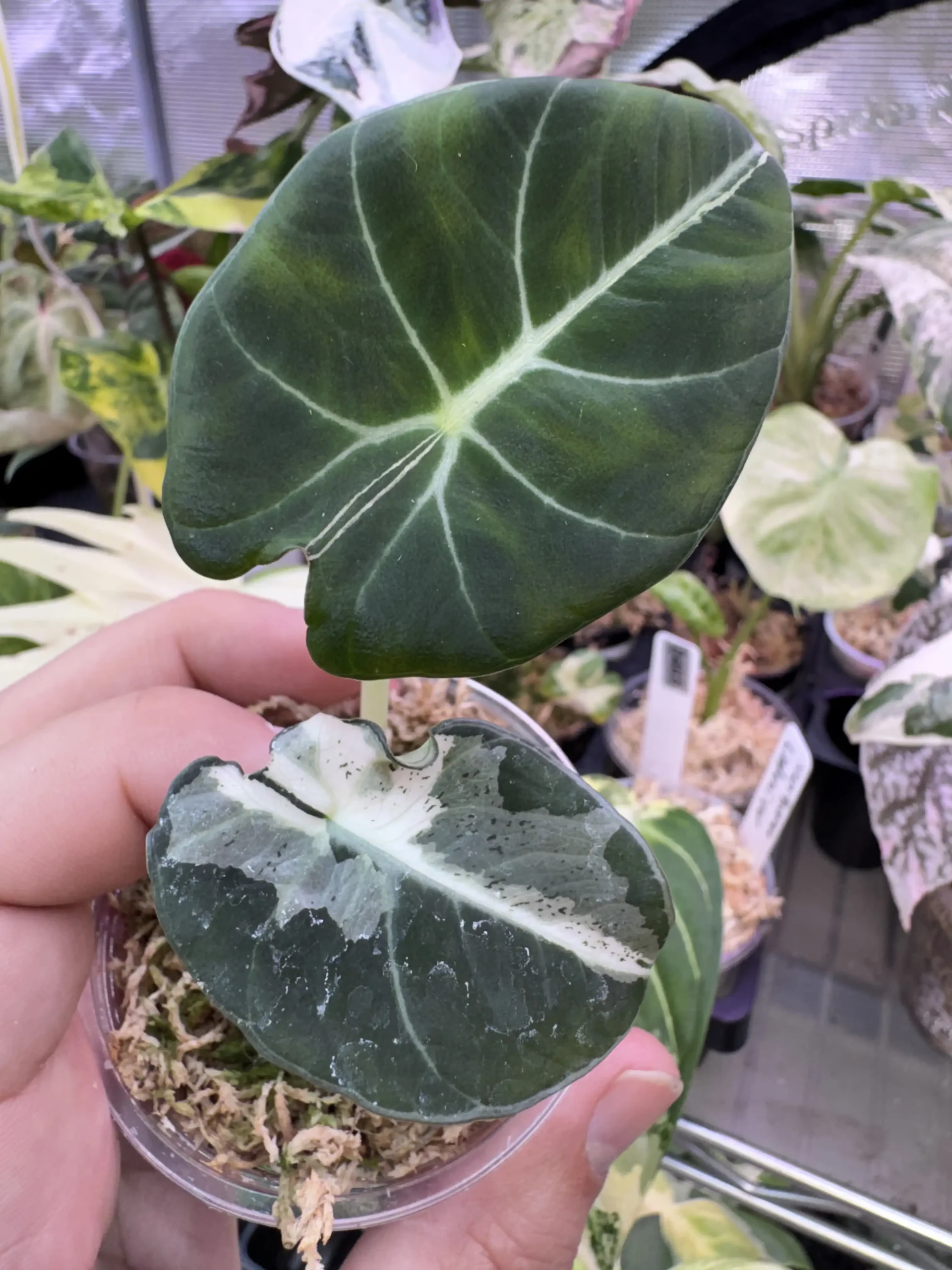
Alocasia Black Velvet ‘Dalmatian’ Variegated #595
$250.00
In stock
Exact Plant
Image taken 5-18-26
Alocasia Black Velvet Dalmatian Variegated – Exact Plant #595
If you know what an Alocasia Black Velvet is, you already understand why the Dalmatian variegated form is special. If you are new to this plant – welcome to your next obsession. Exact Plant #595, the Alocasia Black Velvet Dalmatian Variegated, is one of the most visually striking jewel aroids available anywhere. Near-black velvety foliage. Bold silver-white venation. And scattered across that dark surface, a constellation of creamy white and ivory Dalmatian-style spots that make every leaf look like something out of a botanical illustration. The specific plant photographed is exactly what ships to you.About Alocasia Black Velvet
The Black Velvet is not a hybrid or a cultivar selection – it is its own distinct species: Alocasia reginula. It is native to one very specific place in the world: the shaded limestone cliffs and rocky forest slopes of the Tabin Wildlife Reserve in Sabah, Malaysian Borneo. That narrow native range is part of what makes this species so unusual in the Alocasia genus – while most Alocasia are adaptable growers found across broad tropical regions, the Black Velvet evolved in and adapted to a very specific microhabitat, and every characteristic that makes it so visually extraordinary is a product of those conditions. The leaves are compact, rounded-heart-shaped, and covered in a surface that earns the name every single time someone sees it for the first time. Deep, dark, saturated green that reads as near-black in most lighting conditions, with a matte suede-like texture that looks as soft as it feels. Bold silver-white veins cut across the dark surface with exceptional clarity and contrast. The plant stays compact – a quality that makes it perfectly suited for shelves, desktops, and grow setups where space is at a premium and visual impact per square inch matters.The Dalmatian Form
The Dalmatian designation refers to the specific variegation pattern that defines this form of the Black Velvet. Where the standard variegated Black Velvet forms may express pink tones or broad sectoral cream patches, the Dalmatian presents as scattered constellation-like white and cream speckles distributed across the leaf surface – irregular, unpredictable, and visually reminiscent of the coat pattern that gave this form its name. The effect is remarkable. Against the near-black velvety backdrop and the silver venation that was already dramatic on its own, the Dalmatian splash pattern adds a third visual layer that makes the leaf surface genuinely complex and captivating. No two leaves will ever express the same pattern. Some leaves will show heavy white splashing across broad areas; others will be subtler with finer constellation speckle; the next may show bold irregular sectors. The variegation is chimeric and will continue to evolve as the plant grows and produces new leaves. >Near-black velvety matte leaf surface – the defining characteristic of Alocasia reginula >Bold silver-white venation with exceptional contrast against the dark base color >Dalmatian-style white and cream speckled constellation variegation – unique pattern per leaf >Compact growth habit – ideal for shelves, terrariums, and premium grow setups >Limited availability – far from mass-produced, supply stays genuinely restrictedCare Guide
Light: Bright indirect light from a north or east-facing window is ideal. The Black Velvet evolved in the shaded, filtered light of a Bornean forest understory, and it will perform best in conditions that replicate that environment – plenty of light, but none of it direct. A quality grow light at moderate intensity works very well and is the preferred setup for collectors who want to see this plant at its most active. Direct sun will bleach the dark velvet surface and permanently damage the variegated areas – avoid it entirely. Watering: Allow the top 1 inch of growing medium to dry between waterings, then water thoroughly and let it drain fully. The Black Velvet is more sensitive to overwatering than many Alocasia – its compact root system and the chunky, rocky substrate it evolved in naturally means it expects excellent drainage and periods of relative dryness between waterings. Sharp drainage is non-negotiable. Filtered or distilled water is strongly recommended for this species, as it can be sensitive to fluoride and salts in tap water over time. If you use tap water, let it sit overnight before applying. Humidity: High humidity is essential. Aim for 65 to 80 percent at minimum. The Black Velvet's matte velvet surface is an indicator of a plant that evolved in consistently humid conditions, and both the foliage quality and the variegation integrity suffer noticeably in dry air. Tip browning and margin damage in the variegated areas are the first signs that humidity is too low. A dedicated humidifier is the most effective solution. A grow cabinet or terrarium setup is ideal for keeping this species at its absolute best. Do not mist the leaves – standing water on the velvet surface can cause spotting and fungal issues. Temperature: Keep it warm and very stable between 65 and 80 degrees Fahrenheit (18 to 27 degrees Celsius). The Black Velvet is particularly sensitive to temperature fluctuations – more so than most Alocasia. It evolved in a stable, consistently warm Bornean forest microclimate and reacts visibly to drafts, cold exposure, and sudden changes. Stable warmth with no cold exposure is one of the most important things you can provide for this plant. Keep it away from air conditioning vents, cold windows, and outdoor temperatures below 60 degrees Fahrenheit. Soil: A very well-draining, chunky, rocky aroid mix is the target. A blend of coco coir, perlite, orchid bark, and charcoal mimics the limestone substrate this species evolved in and provides the sharp drainage it needs. Avoid any soil that holds moisture against the root zone. Some collectors grow the Black Velvet in a mix heavy on perlite and pumice for maximum drainage with excellent results. Pot size: Keep it slightly snug. The Black Velvet prefers being somewhat root-bound and will respond poorly to oversized pots where excess soil holds moisture around the roots. Terracotta pots are an excellent choice for this species – the porous walls help wick excess moisture away from the root zone and provide additional airflow. Dormancy: Like all Alocasia, the Black Velvet may go dormant in fall and winter, dropping leaves and retreating to its corm. This is normal behavior and not a sign of a dying plant. Reduce watering significantly during dormancy, hold off on fertilizer, and wait for spring conditions to encourage new growth. The corm will push again when it is ready. Fertilizing: Light and infrequent during the growing season. A balanced liquid fertilizer at quarter to half strength every 6 to 8 weeks in spring and summer is sufficient. The Black Velvet's compact size and naturally rocky native substrate means it is not a heavy feeder – less is more with this species. Toxicity: Alocasia reginula Black Velvet Dalmatian Variegated is toxic to cats, dogs, and humans if ingested. Contains calcium oxalate crystals which cause oral irritation, swelling, and gastrointestinal distress. Keep away from pets and children at all times.Shipping
This is an exact plant listing – Plant #595 ships precisely as shown in the product photos. We ship Monday through Wednesday to avoid weekend transit delays. Every plant is carefully packaged to protect the delicate velvet foliage and root system during transit. Reach out before ordering if you have any questions about this specific plant or want additional photos.Every Leaf Tells a Story in our collection. Hand-selected, carefully shipped, and trusted by plant lovers nationwide. Get first access to limited genetics and healthy, acclimated plants.
© 2026 The Plant Nook Shop
Powered by SmallBiz.Reviews