
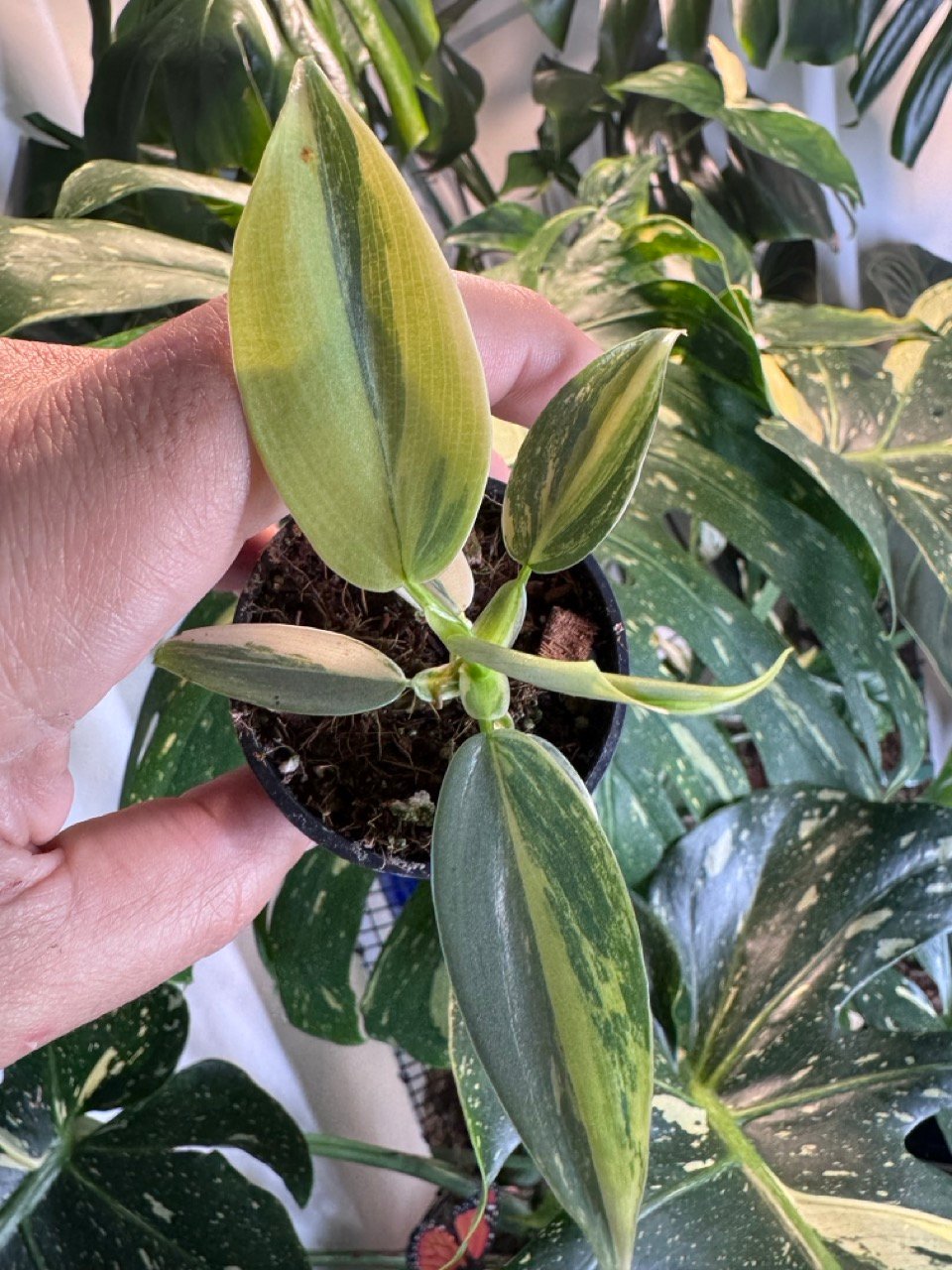
philodendron silver sword variegated #565
$105.00
In stock
Exact plant #565
Image taken 5-16-26
Philodendron Silver Sword Variegated For Sale – Exact Plant #565
Some plants earn their collector status through rarity alone. The Philodendron Silver Sword Variegated earns it through a combination of rarity, visual impact, and a backstory that makes owning one feel genuinely significant. Exact Plant #565 is a rooted, established specimen of one of the most sought-after variegated Philodendron in cultivation — and as an exact plant listing, the specific specimen photographed is precisely what ships to you. The standard Philodendron hastatum — the Silver Sword — is already a plant that commands attention. Native to the Atlantic coastal forests of southeast Brazil, it is classified as endangered in its native habitat, a species whose natural range has contracted significantly due to deforestation. In cultivation it has become one of the most beloved climbing Philodendron in the hobby, prized for leaves that are genuinely unlike anything else in the genus: elongated, lance-shaped, and coated in a metallic silver-blue sheen that reflects light with a cool, almost otherworldly quality. Juvenile leaves are broader and more ovate; as the plant matures and climbs, each successive leaf elongates further and sharpens to a more pronounced point, the silver intensity deepening with each new growth. The common name — Silver Sword — is not a stretch. These leaves genuinely look like blades. The Variegated form — Philodendron hastatum variegata — takes that already extraordinary foundation and layers creamy, irregular variegation across the silver-blue surface. The result is a three-tone composition of silver-blue base, crisp green undertones, and soft cream to white variegation that creates a contrast as refined and elegant as any Philodendron in cultivation. It is consistently among the most requested variegated Philodendron species in collector communities, and rooted exact-plant specimens with strong variegation expression are rarely available at accessible price points.What to Expect From This Plant
The Silver Sword is a climber by nature — in its native Brazilian forest habitat it ascends tree trunks using aerial roots, and the leaf form responds directly to having a support structure to climb. Without a support, the plant grows more compact and the leaves stay relatively smaller. With a moss pole or coco coir totem, the plant pushes upward, the petioles elongate, and successive new leaves become progressively larger and more sharply defined — eventually reaching the dramatic, elongated adult form that makes large, mature Silver Sword specimens so striking. Starting with a support structure early is one of the most impactful things you can do for this plant's long-term development. As a variegated specimen, Plant #557 will express variegation differently on each new leaf — the distribution of cream and silver tones is chimeric in nature and will never repeat identically. Some leaves may show broad creamy sectors; others may express delicate streaking or marbling. The variegation tends to become more defined and expressive as the plant settles into its growing environment and produces successive new growth after acclimation.Care Guide
Light is where the Silver Sword shows its flexibility compared to some of the more demanding collector aroids. It performs well in bright indirect light and can handle some gentle morning direct sun from an east-facing window without damage — something relatively few collector Philodendron can tolerate. That said, the silver metallic sheen of the foliage is its most prized quality, and if it begins to fade or dull, it is almost always a signal that the plant needs more light rather than less. Move it closer to the window or add a grow light. Avoid intense afternoon direct sun, which will bleach the silver tones and damage the variegated portions of the leaf permanently. Watering is forgiving and straightforward. Allow the top one to two inches of the growing medium to dry between waterings, then water thoroughly and allow full drainage. The Silver Sword is more tolerant of slight underwatering than overwatering — its roots do not like to sit in soggy media, and consistent overwatering is the most common cause of decline in this species. A well-draining aroid mix and a pot with good drainage holes will handle the rest. Humidity should be maintained at 50 percent or above for best results. The Silver Sword is one of the more adaptable collector Philodendron in terms of humidity tolerance — it will survive in standard indoor ambient conditions better than most of the velvet Anthurium or jewel Alocasia in our collection. That said, elevated humidity of 60 to 70 percent will produce noticeably larger leaves, more intense silver coloration, and faster overall growth. A humidifier or pebble tray will make a meaningful difference if you want to see this plant at its best. Temperature should stay warm and comfortable between 65 and 85 degrees Fahrenheit (18 to 29 degrees Celsius). The Silver Sword is a tropical Brazilian species and appreciates consistent warmth, but it is among the more temperature-tolerant climbing Philodendron in cultivation. Avoid cold drafts, air conditioning vents, and temperatures below 55 degrees Fahrenheit, all of which will trigger stress and leaf yellowing. Soil should be well-draining, airy, and loose. A mix of standard potting soil, perlite, and orchid bark in roughly equal parts works well. The Silver Sword's root system likes to breathe — avoid dense, compacting soils that hold moisture against the roots. Repot in spring every one to two years as the plant grows, moving up one pot size at a time. Support is important for long-term development and leaf size. A moss pole, bamboo stake, or coco coir totem gives the aerial roots something to grip and signals to the plant to produce the elongated, adult-form leaves that define the Silver Sword at its most impressive. Install the support early — it is significantly easier to add before the plant is established around a pot than after. Fertilizing should be consistent and moderate. A balanced liquid fertilizer at half strength applied monthly during the growing season (spring through summer) feeds the active growth without risking fertilizer buildup that can affect the leaf surface finish. Reduce or eliminate feeding in fall and winter. Toxicity: Philodendron hastatum is toxic to cats, dogs, and humans if ingested. It contains calcium oxalate crystals, which cause oral irritation, swelling, and gastrointestinal distress. Keep out of reach of pets and children at all times.Shipping
This is an exact plant listing — Plant #565 ships precisely as shown in the product photos. We ship Monday through Wednesday to prevent weekend transit delays and ensure your plant arrives in excellent condition. Every plant is carefully packaged to protect the foliage and root system during transit. If you would like additional photos or have any questions about this specific plant before purchasing, please reach out before placing your order.Every Leaf Tells a Story in our collection. Hand-selected, carefully shipped, and trusted by plant lovers nationwide. Get first access to limited genetics and healthy, acclimated plants.
u00a9 2026 The Plant Nook Shop
Powered by SmallBiz.Reviews