
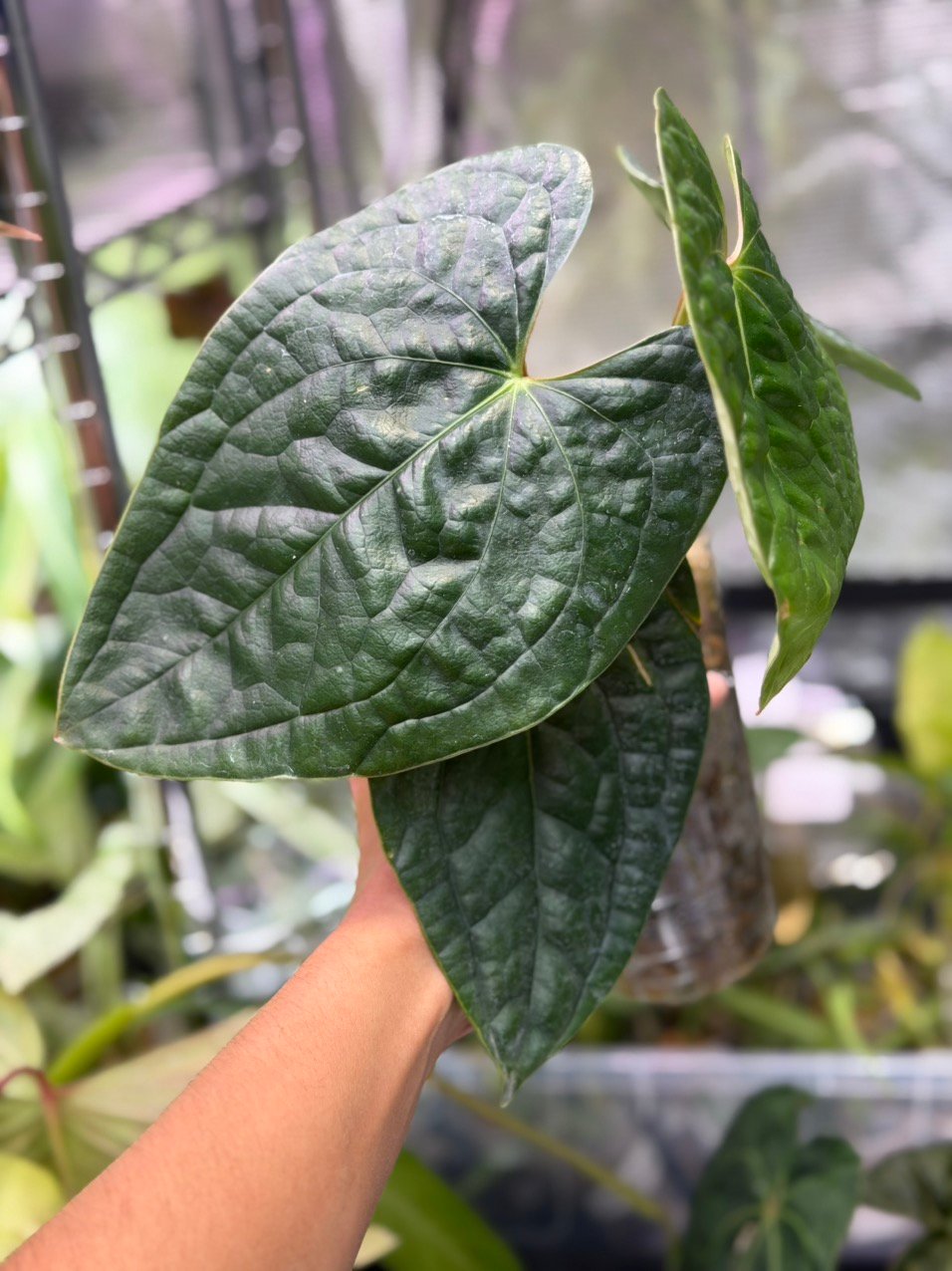
Anthurium Luxurians Selfing #493
$30.00
In stock
Exact Plant #493
Image taken 5/15/26
Anthurium Luxurians Selfing – Exact Plant #0493
The name says everything about what this plant aspires to be. Luxurians — from the Latin for "luxuriant, abundant, extravagant" — and this species earns every syllable of it. Exact Plant #0493, the Anthurium Luxurians Selfing, is a pure-species specimen produced through deliberate self-pollination — meaning the parent plant was pollinated with its own pollen to produce offspring that carry the full, uncompromised genetic expression of Anthurium luxurians at its most true-to-type. No crossing, no dilution of the traits that make this species so extraordinary. Just the Luxurians, faithfully reproduced. Native to the humid, low-light tropical forests of Colombia and Ecuador — where it was once known under the trade name Anthurium splendidum before its current accepted name was established — the Luxurians grows in conditions of deep forest shade and consistently high humidity, and it adapted to those conditions in a way that no other Anthurium species quite replicates. The leaves are broad, ovate, and deeply bullate: covered in a dense pattern of raised, blistered bumps that give the surface a quilted, almost three-dimensional quality that you notice immediately and cannot stop touching once you have. That texture is not merely decorative. It is functional — the blistered surface increases total leaf area for maximum light absorption in low-light conditions, while the raised channels formed between the bumps act as drainage pathways, whisking water off the leaf surface and keeping it dry against fungal pressure. The plant's own architecture is a solution to its environment, and that is the kind of elegant biological design that makes serious plant people fall deeply in love with this genus. The color deepens as the plant matures. Juvenile leaves often emerge with a bronzed, coppery flush that gradually settles into the inky, dark emerald green the species is known for at maturity — a green so deep and saturated it reads almost black in certain light conditions. The contrast between that near-black backdrop and the pale, raised venation creates a visual depth that photographs beautifully and looks even more compelling in person. This is an exact plant listing. Plant #0493 — the specific specimen photographed — is precisely what ships to you.About the Selfing
When collectors see "Selfing" next to an Anthurium species name, it carries specific meaning. A selfed plant is the product of a controlled self-pollination — the parent plant pollinated with its own pollen, producing seeds that develop into offspring sharing very close genetics with the parent. For a species as visually distinctive as Anthurium luxurians, selfing is a deliberate choice: it preserves the bullate texture, the dark color depth, the leaf shape, and the overall character of the species without introducing the uncertainty of a hybrid cross. Collectors who want a pure Luxurians — not a hybrid, not a cross, not a diluted version of its best traits — seek out selfed seedlings precisely for this reason. What you are getting with Plant #0493 is a specimen that carries the full species identity of Anthurium luxurians as faithfully as a seed-grown plant can.Care Guide
Light for the Luxurians is on the lower end of the aroid spectrum by design — this is a species adapted to deep forest understory conditions, and it will perform well in light levels between 2,000 and 4,000 LUX. Bright indirect light that would be comfortable for reading — a position near an east-facing window, or under a grow light at moderate intensity — is ideal. Unlike many collector Anthurium that demand maximum brightness to express their best foliage, the Luxurians is more forgiving of lower light than most and will not punish you for a slightly shadier placement. That said, avoid truly dim conditions, which will slow growth and reduce the intensity of the bullate texture over time. Direct sun should be avoided entirely — it will scorch the dark foliage quickly and irreversibly. Watering follows the standard aroid approach. Allow the top two inches of the growing medium to approach dryness before watering thoroughly and allowing full drainage. The Luxurians has large, juicy roots that store moisture, making it somewhat forgiving of occasional missed waterings but highly susceptible to root rot in consistently soggy conditions. When in doubt, lean toward underwatering rather than overwatering — the plant will recover from slight dehydration far more easily than from root damage. Use room-temperature water and make sure the pot drains freely every time you water. Humidity should be maintained at 60 percent or above for optimal health and leaf development. The Luxurians is a Colombian and Ecuadorian forest species and performs noticeably better in elevated humidity — new leaves emerge larger, the bullate texture develops more fully, and the deep color intensity of the mature foliage is more pronounced. A humidifier, grow cabinet, or even a pebble tray beneath the pot will provide meaningful benefit. The bullate texture of the leaves means water does not sit on the surface easily, so light misting is less of a concern with this species than with flat-leafed velvet Anthurium — though a humidifier remains the most effective and consistent solution. Temperature should stay warm and stable between 65 and 85 degrees Fahrenheit (17 to 29 degrees Celsius). The Luxurians is tolerant of a slightly broader temperature range than some collector Anthurium and can handle brief dips to around 45 degrees Fahrenheit without permanent damage, though prolonged exposure to temperatures outside its preferred range will stunt growth and compromise health. Consistency matters more than precision — avoid temperature swings, cold drafts, and air conditioning exposure. Soil should be well-draining, airy, and loose. A quality aroid mix incorporating perlite, orchid bark, and coconut coir works well. The large root system appreciates space and airflow, so avoid compacting the growing medium. Repot every one to two years in spring as the plant grows — the Luxurians has a moderate growth rate and will produce three to five new leaves every six months under ideal conditions. Fertilizing is beneficial but should be kept light. A slow-release fertilizer like Osmocote applied every three to six months works well and is easy to manage. If you prefer liquid feeding, fish emulsion diluted to one-quarter strength applied weekly or bi-weekly during the growing season produces excellent results — the Luxurians responds very well to regular, modest nutrition rather than heavy periodic application. Toxicity: Anthurium luxurians is toxic to cats, dogs, and humans if ingested. It contains calcium oxalate crystals, which cause oral pain, swelling, and gastrointestinal irritation. Keep out of reach of pets and children at all times.Shipping
This is an exact plant listing — Plant #0493 ships precisely as shown in the product photos. We ship Monday through Wednesday to prevent weekend transit delays and ensure your plant arrives in excellent condition. Every plant is carefully packaged to protect the foliage and root system during transit. If you have any questions about this specific plant or would like additional photos before purchasing, please reach out before placing your order.Every Leaf Tells a Story in our collection. Hand-selected, carefully shipped, and trusted by plant lovers nationwide. Get first access to limited genetics and healthy, acclimated plants.
u00a9 2026 The Plant Nook Shop
Powered by SmallBiz.Reviews